In the Supply Chain Tribe by Celerity - July 2026 Edition
by Dr. Sourabh Bhattacharya, Dean (Academics) and Professor of Operations and Supply Chain Management, Institute of Management Technology, Hyderabad and Arisha Ali Rahi, Evernorth Health Services
The future of logistics mobility is being shaped by speed, intelligence, and the ability to operate efficiently in increasingly complex environments. In India, where congestion, fragmented infrastructure, and rising delivery expectations continue to strain freight networks, emerging technologies are forcing a rethink of conventional mobility models. This article by Dr. Sourabh Bhattacharya, Dean (Academics) and Professor of Operations and Supply Chain Management, Institute of Management Technology, Hyderabad and Arisha Ali Rahi, Business Project Associate, Evernorth Health Services, explores how autonomous systems, drone logistics, connected vehicle ecosystems, and AI-driven fleet intelligence are being adapted for India’s uniquely dynamic operating landscape. Rather than replicating Western frameworks, the focus is shifting toward frugal, scalable, and highly adaptive innovation capable of transforming freight efficiency and creating a globally relevant model for the next generation logistics mobility.
Dr. Sourabh Bhattacharya
Let us take a look at the daily reality of a metropolitan hub in a developing nation and follow the journey of a commercial freight vehicle as it attempts to traverse this environment. The economic engine of the metropolitan hub is severely handicapped by an inescapable, glaring problem: a paralyzing, chronic state of gridlock. This is a critical issue from an operations and logistics management standpoint because it represents a systemic bottleneck in the metropolitan supply chain. It is the direct outcome of unstructured, rapid urbanization violently crashing into a physical infrastructure that is woefully inadequate and outdated.
This is the root cause of spiralling logistics costs, unpredictable delivery times, and a general degradation in freight network efficiency. When the standard deviation in delivery times can range from minutes to hours, the concept of “Just In Time” (JIT) inventory and tightly scheduled truck fleets becomes completely obsolete. With increasing urban density and rising expectations of 10 minute commerce, the conventional road based freight infrastructure is becoming fundamentally overwhelmed, leading to a fractured and inefficient urban logistics system.
This is not a hypothetical scenario; it is the gritty ground reality in all major cities in India. The solution requires a radical rethinking of how we move not just people but, more importantly, goods—from containers and pallets to blood samples and e commerce parcels. The global transportation and logistics landscape is in the midst of a revolutionary technological shift driven by automation, digital intelligence, advanced data analytics, and electrification. New vehicle technologies are radically changing the face of global mobility and logistics. This paradigm shift rests on four primary pillars: Autonomous Mobility, Drone Logistics, Urban Air Mobility & Advanced Air Mobility (UAM & AAM), and Connected Vehicle Technology (V2X).
Arisha Ali Rahi
However, the integration of these technologies into freight operations is highly fragmented worldwide. Operational playbooks that work in the highly structured environments of the West and China cannot simply be transposed to the Indian subcontinent. Achieving similar success in India is not just difficult; it is a highly localized logistics innovation challenge. Attempting to transplant deterministic Western technology into the high entropy Indian landscape is like trying to run a bullet train on gravel.
THE CASE OF AUTONOMOUS NAVIGATION IN HIGH ENTROPY FREIGHT CORRIDORS
One of the most visible disruptions in logistics is autonomous mobility. From an operational perspective, the foundational objective is to remove human error from the system, which causes the majority of road accidents and contributes to unpredictable dwell times and fleet utilization. In freight operations, removing variance is critical because variance disrupts flow, increases buffer inventories, and inflates working capital.
In developed economies, rigid deployment methodologies aim to minimize variance. Companies like Alphabet’s Waymo and Amazon’s Zoox focus on structured urban grids for robotaxis, while Aurora Innovation leverages predictable interstate corridors like Texas I 45 to deploy commercial driverless trucking services. These freight pilots rely on consistent lane markings, disciplined driver behaviour, and high quality infrastructure.
The Indian scenario makes this rigid approach inefficient for logistics fleets. Indian traffic presents a high entropy environment: constrained geometries, limited lane discipline, heterogeneous vehicle mixes from trucks to two wheelers, and unpredictable behaviour from pedestrians and even stray cattle. A Western AV algorithm that is programmed to halt whenever an unpredictable variable appears would leave an autonomous truck permanently parked in Mumbai traffic.
To address this, Indian start ups are redesigning AI frameworks away from rigid rulebooks towards predictive negotiation—exactly what is needed for logistics fleets that must continuously thread through chaos. Swaayatt Robots uses Deep Reinforcement Learning to train AI agents via millions of simulations rather than relying on costly high definition maps. This makes it possible to deploy autonomous capabilities for logistics even where road infrastructure is unsystematized, dramatically lowering the cost of maintaining digital maps. Minus Zero uses nature inspired AI to focus on context and outcomes instead of heavy object classification pipelines, predicting collision trajectories with light neural nets and multiple cameras. This cuts dependence on expensive LiDAR arrays and makes autonomy more viable for cost sensitive freight applications.
THE CASE OF LEAPFROGGING VIA DRONE LOGISTICS
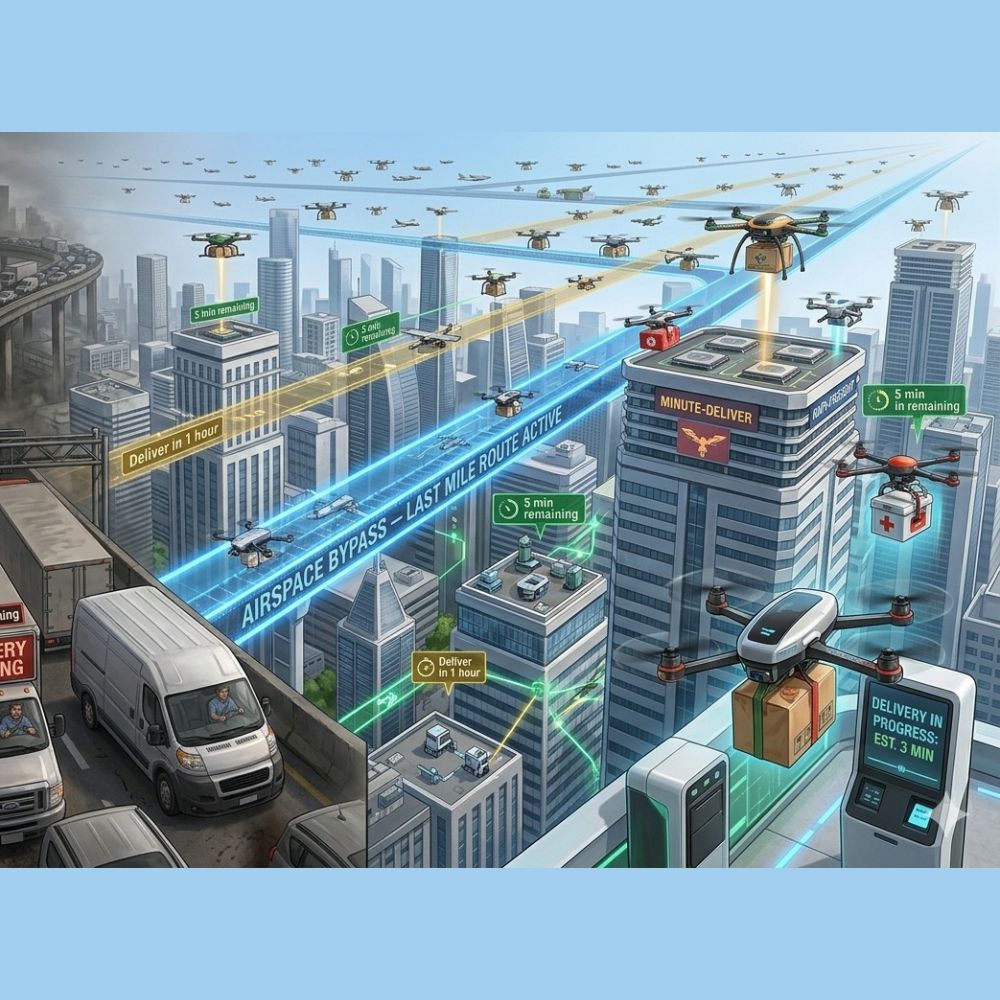
As consumer expectations shift from “next week” to “next hour,” the logistics system, not just passenger transport, faces relentless pressure to deliver faster, cheaper, and more reliably. We are moving from a paradigm of days to a paradigm of minutes, especially in last mile and mid mile deliveries. In this context, drone logistics has leapfrogged from pilot projects to industrial scale operations in record time and is emerging as a critical answer to the last mile and hard to reach mile problem. According to the theory of constraints, if we cannot expand the capacity of the physical bottleneck (congested roads), we must route around it. Airspace is the ultimate bypass for cargo flows.
Globally, the operational focus of drone logistics has been on suburban convenience and medical supply chains. Wing, a subsidiary of Alphabet, uses a sophisticated Autonomous Airspace Management System (AAMS) to orchestrate hundreds of daily drone flights, targeting a package every 30 seconds within its zones. Manna in Europe operates eVTOL drones as a high frequency aerial conveyor belt for suburban deliveries, with drop times under three minutes. Zipline runs the world’s largest medical drone delivery network, using fixed wing aircraft to transport blood and vaccines up to 150 km into remote regions—core logistics missions where reliability and cold chain integrity are paramount.
For India, integrating AI and drone technology is less about delivering coffee and more about building an alternative logistics infrastructure layer. India has quickly become one of the most exciting drone markets, using aerial logistics to overcome geographic and infrastructure constraints rather than just adding convenience.
Fully autonomous drones are being developed by Redwing Labs, a Bengaluru based company, to serve difficult terrains. Their beyond visual line of sight (BVLOS) operations deliver temperature controlled vaccines and diagnostic samples to rural communities and primary health centres in Arunachal Pradesh and Odisha. From a logistics standpoint, they are solving one of the hardest problems: maintaining an unbroken cold chain. By slashing transit times, they practically eliminate spoilage risk.
TechEagle operates hybrid eVTOL drones for emergency healthcare and disaster response logistics. With over 500,000 kilometres of autonomous BVLOS operations and a 10 minute diagnostic service with Apollo Hospitals, they demonstrate how aerial fleets can shave critical minutes off emergency logistics, where response time directly correlates with survival.
Indian innovation is also revolutionizing aerodynamic hardware to relentlessly pursue reductions in operating costs. Airbound’s blended wing body tailsitter prototype, with thrust vector control, offers up to six times more aerodynamic efficiency than traditional multicopter drones. For logistics operators, this translates directly into lower cost per kilogram kilometre and improved fleet economics—critical in a price sensitive market.
In densely populated urban centres, Skye Air has proven its scalability by targeting 2 million drone deliveries by the end of 2025. By optimizing flight paths with proprietary unmanned traffic management software, Skye Air is cutting urban transit times to under seven minutes in cities like Gurugram. Here, drones function as a parallel express network for small cargo, relieving pressure on overburdened road based last mile fleets.
In sum, drone logistics is not a futuristic add on; it is a core logistics capability enabling India to leapfrog over traditional road centric bottlenecks.
THE CASE OF THE URBAN SKY COMMUTE (CARGO VS. PREMIUM PASSENGERS)
Urban Air Mobility (UAM) and eVTOL aircraft are the most visually dramatic innovations: flying taxis that promise to lift commuters above ground congestion. However, from a logistics perspective, their current role in India is more symbolic than systemic. They primarily target premium passengers rather than carrying significant cargo volumes.
Western developers like Joby Aviation and Archer Aviation are investing heavily to meet stringent certification standards and deploy urban air taxi fleets. In Eastern markets, EHang has already obtained full commercial certification for autonomous air taxis in Chinese cities, while the UAE is granting exclusive operating rights for such services.
In India, UAM is motivated by the economic cost of congestion but is positioned as a premium commute rather than mass or cargo transit. InterGlobe’s partnership with Archer aims to deploy 200 “Midnight” aircraft, cutting the Connaught Place–Gurugram trip from 90 minutes to seven. Eve Air Mobility with Blade India similarly plans to shorten the 2.5 hour drive between Bengaluru airport and city hubs.
From a logistics standpoint, these services are high margin but low throughput. Carrying four ultra wealthy travellers per flight does little to improve the overall throughput of millions of commuters or the daily megatonnes of urban freight. Moreover, vertiport development in dense cities faces immense zoning and bureaucratic friction. For now, the true logistics impact lies not in eVTOL taxis but in cargo first drone networks and high utilization ground fleets augmented by digital intelligence.
THE CASE OF DIGITAL ECOSYSTEMS, V2X, AND FLEET LOGISTICS
None of these new vehicles—whether trucks, vans, two wheelers, or drones—operate in a vacuum. They require a digital nervous system, often referred to as Connected Vehicle Technology or V2X (Vehicle to Everything). For logistics, this effectively creates a digital twin of the fleet and infrastructure, shifting from passive protection (insurance after accidents) to active, collaborative prevention and optimization (avoiding breakdowns, rerouting around congestion, and predicting failures).
China’s vehicle road cloud integration sends traffic signal data to vehicles in cities like Wuxi and uses roadside cameras and LiDAR in Changsha to support autonomous decisions. In the U.S., projects like Tampa apply V2X to prevent wrong way collisions. These deployments directly support more reliable freight flows by smoothing throughput and improving safety.
India cannot afford such capital intensive, greenfield infrastructures at scale. Instead, frugal logistics innovation leads the way. Indian OEMs are embedding IoT connectivity into vehicles using existing cellular networks (V2N). Platforms like MG’s iSMART and similar offerings from Kia and Hyundai offer remote immobilization, geofencing, and telemetry using ordinary 4G/5G subscriptions—without expensive roadside units.
In commercial fleets, organizations like Intangles use digital twin technology to collect engine management data from trucks and buses, uploading it to the cloud to predict component failures before they occur. This enables predictive maintenance and improves fleet uptime and asset utilization—key levers in logistics profitability.
Given the dominance of two wheelers in India’s last mile delivery fleets, V2P (Vehicle to Pedestrian/Motorcyclist) solutions from companies like Honda, which use smartphones as beacons, are essential. They help larger vehicles detect riders hidden in blind spots, reducing last mile accident risk.
On the infrastructure side, research bodies like C DAC are creating low cost C V2X adapters that retro fit existing traffic signal controllers. These enable smart traffic functions such as ambulance priority corridors without replacing legacy hardware. This is classic frugal engineering: extracting maximum logistics benefit with minimal capital expenditure.
BARRIERS TO SCALABLE LOGISTICS IMPLEMENTATION
The theory behind autonomous fleets, drone logistics, and V2X is exciting, but the practical application in India faces significant friction. Root cause analysis reveals that assuming Western mobility and logistics blueprints will seamlessly work in Indian conditions is fundamentally flawed. Developed economies are layering digital systems onto already reliable physical roads. India is attempting to run advanced logistics intelligence over a physical layer that is strained, flood prone, and highly variable. A pothole cannot be patched with an algorithm.
Machine learning models trained on highly compliant Western traffic do not generalize to India’s high entropy freight corridors. Deterministic planning approaches and classical safety stocks fail under such variability. AI architectures must be redesigned towards robust, camera based predictive analytics and frugal sensing, rather than brittle, expensive LiDAR stacks.
Capital intensity is another barrier. AI, advanced sensors, and drone networks are expensive, while Indian consumer and B2B markets are price sensitive. Economic viability demands frugal engineering: smartphones as V2P devices, low cost V2X adapters, camera only ADAS, and highly efficient drone airframes. In logistics, unit economics— not just technological elegance— determines adoption.
THE LEAPFROG OPPORTUNITY IN LOGISTICS
The mobility sector has reached an inflection point, and these new vehicular technologies—autonomous fleets, drone networks, V2X ecosystems—are here to stay. As the world evolves, so will the way global supply chains and freight flows are managed.
India’s path will not be a copy of Western blueprints. Success will not come from simply importing foreign AI and logistics platforms, but from operations driven innovation tuned to Indian constraints. AI must be trained to understand chaos; drone networks must be architected as parallel logistics layers that bypass gridlocked roads; telecom networks must be leveraged as the backbone for connected fleets instead of waiting for perfect smart city infrastructure.
If India gets this right, it has an extraordinary opportunity to leapfrog: to bypass antiquated, road heavy logistics models and build a uniquely resilient, frugal, and digitally integrated freight ecosystem. Such a system would not only transform cargo movement within India but could also become the reference model for logistics innovation across the developing world.


 Categories