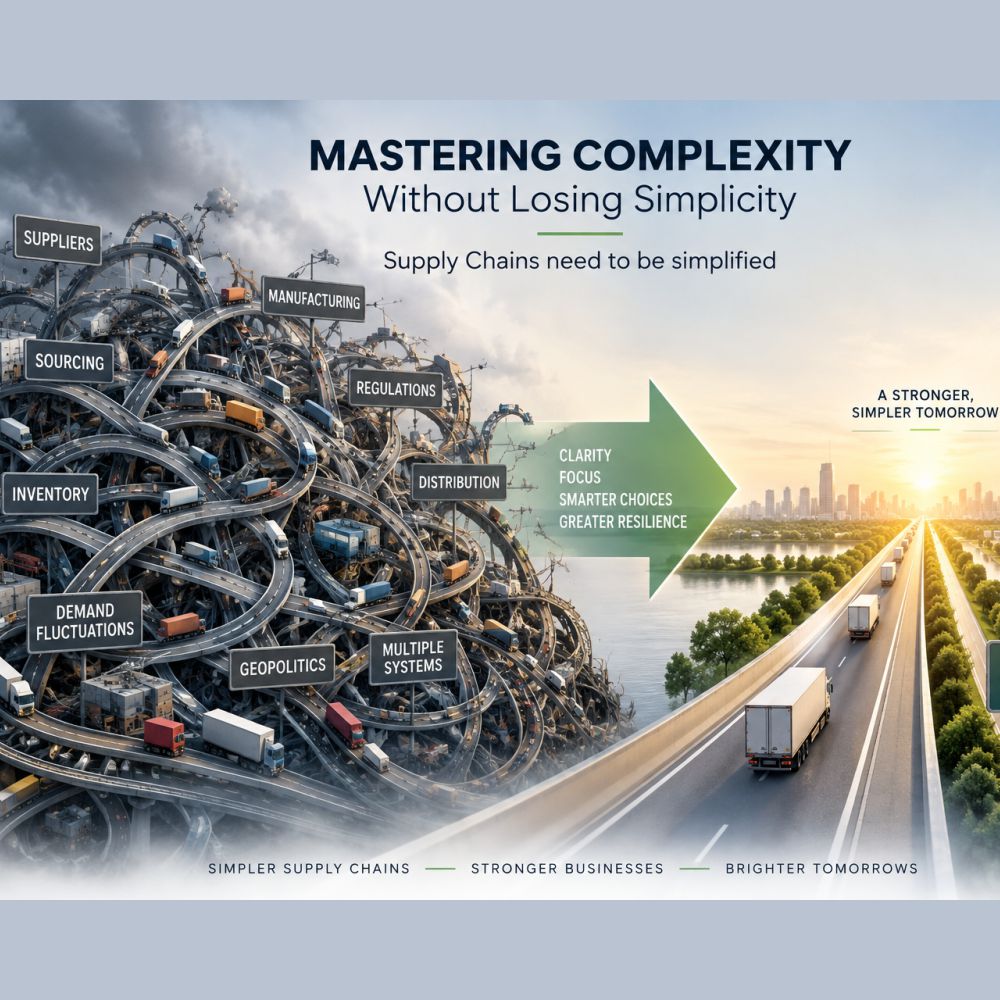
Modern supply chains are under pressure to be faster, smarter, and more customer-centric than ever before—without sacrificing operational efficiency. As complexity becomes the new normal, the ability to simplify execution is emerging as a decisive competitive advantage, decodes Dr. Radha Mohan Gupta, Adjunct Professor, IMT Ghaziabad.
For decades, supply chains were largely designed around one central objective—cost reduction. Efficiency was the dominant philosophy. Organizations focused on optimizing procurement, minimizing inventory, improving asset utilization, standardizing operations, and reducing logistics costs. The most successful supply chains were those that consistently delivered products at the lowest possible cost. That model worked well in a relatively stable world.
Dr. Radha Mohan Gupta
Today’s markets, however, are far more dynamic, fragmented, and unpredictable. Consumer preferences evolve rapidly, product lifecycles continue to shrink, and technology is constantly reshaping buying behaviour. More importantly, customer expectations are no longer driven by price alone. Increasingly, they are driven by convenience.
As highlighted by recent NielsenIQ research, the rise of the “convenience economy” is redefining consumer choice. Speed, flexibility, omnichannel access, real-time visibility, and seamless buying experiences are becoming critical differentiators, particularly among Gen Z consumers who have grown up in a digital-first environment. For them, convenience is not an added advantage—it is a basic expectation.
Customers today expect faster deliveries, personalized choices, multiple fulfilment options, flexible return policies, and complete visibility across their purchase journey. More significantly, many are willing to pay for these conveniences, fundamentally altering the economics of supply chain design.
This shift challenges the traditional philosophy of building supply chains around the principle of “least cost.” While cost efficiency remains essential and will always influence competitiveness, it is no longer sufficient to win markets. Responsiveness, flexibility, resilience, and customer experience have become equally important. The supply chains of tomorrow will compete not merely on efficiency but on relevance.
Consequently, supply chains are no longer functioning simply as backend operational systems. They are increasingly becoming strategic differentiators and direct enablers of business growth. In many industries today, the customer experience itself is shaped by supply chain capability. A delayed delivery, product stock-out, poor returns process, or lack of visibility can directly influence customer loyalty and brand perception.
Conversely, agile and responsive supply chains strengthen customer trust, improve retention, and can even justify premium pricing.
This transformation is also reflected in McKinsey & Company’s research, which increasingly positions supply chains as strategic sources of resilience, competitive differentiation, and long-term value creation rather than merely operational support functions.
THE NEW COMPLEXITY EQUATION
The growing emphasis on customer-centricity is fundamentally changing the architecture of supply chains. Traditional supply chains were relatively linear and predictable. Products moved through established networks—from supplier to factory, factory to warehouse, warehouse to distributor, retailer, and finally to the customer. Optimization was comparatively straightforward because both supply and demand patterns were relatively stable. Modern supply chains, however, are becoming increasingly adaptive and interconnected.
Organizations today continuously redesign sourcing strategies, inventory locations, fulfilment models, transportation networks, and distribution flows to align with rapidly changing market requirements. The rapid expansion of omnichannel retail, quick commerce, micro-fulfilment centres, platform-based ecosystems, and flexible sourcing arrangements has significantly increased the complexity of supply chain operations.
Every additional sales channel, fulfilment option, sourcing location, or product variant creates another layer of operational complexity. SKU proliferation
increases planning challenges. Faster deliveries require denser fulfilment networks. Personalization fragments demand. Multiple channels create inventory dispersion, while dynamic sourcing introduces greater coordination requirements. Simultaneously, customers expect complete visibility and immediate responsiveness across every touchpoint.
In many organizations, operational complexity is growing faster than the managerial capability required to manage it effectively. Yet this is precisely where the defining paradox of modern supply chains emerges. Markets are compelling organizations to become more flexible, agile, and customer-centric, while businesses continue to expect lower costs, lean inventories, and higher operational efficiency. Supply chains are therefore expected to absorb increasing external complexity while delivering internal simplicity.
The challenge is no longer about avoiding complexity—an increasingly impossible objective—but about managing it intelligently without allowing it to overwhelm execution. When left unchecked, complexity often manifests in excessive SKU proliferation, fragmented processes, overlapping technologies, duplicated workflows, slower decision making, and rising operational costs. Ironically, many initiatives introduced to improve customer responsiveness eventually reduce agility because they create unnecessary organizational burden. The real question, therefore, is not how to eliminate complexity, but how to simplify execution despite rising complexity.
That requires a very different philosophy of supply chain management—one that recognises complexity as an inevitable outcome of serving increasingly sophisticated markets while ensuring that internal operations remain disciplined, coordinated, and scalable.
SIMPLICITY AS A STRATEGIC CAPABILITY
For years, organizations pursued simplification primarily through standardization and cost optimization. Those principles remain important, but today’s markets demand a more nuanced approach. Customers expect speed, flexibility, personalization, visibility, and convenience—often simultaneously.
Supply chains can therefore no longer remain static networks optimized solely for efficiency; they must evolve into adaptive ecosystems capable of continuously responding to changing market realities. This evolution is also forcing organizations to rethink the very purpose of supply chains.
Traditionally, supply chain performance was measured through procurement savings, logistics costs, inventory turns, and asset utilization. While these metrics continue to matter, they no longer capture the full strategic value of modern supply chains. Increasingly, supply chains influence customer acquisition, retention, revenue growth, and brand differentiation.
A fast and reliable delivery experience strengthens customer loyalty. Flexible fulfilment models improve conversions. Better product availability directly supports revenue growth, while responsive returns processes reinforce customer confidence. In many industries, customers may never see a manufacturing plant or distribution centre, but they experience the supply chain every time they interact with a brand.
WHEN COMPLEXITY BECOMES A LIABILITY
As supply chains become central to competitive positioning, organizations must also guard against the unintended consequences of pursuing convenience at any cost. Every new fulfilment model, sourcing option, technology platform, or customised process introduces additional operational complexity. Unless carefully governed, excessive SKU proliferation, fragmented networks, overlapping digital systems, and duplicated workflows can reduce agility rather than enhance it. Complexity, if left unmanaged, begins to consume the very efficiencies organizations are striving to protect.
This is precisely why simplification is regaining strategic importance—not as a rejection of complexity, but as the means to manage it intelligently.
Simplification today is no longer about reducing options or enforcing rigid standardization. It is about creating clarity amid complexity. It requires integrated planning, end-to-end digital visibility, intelligent automation, data driven decision-making, and governance models that enable organizations to adapt continuously without creating operational chaos.
Equally important is developing the discipline to distinguish between necessary and unnecessary complexity. Every additional product variant, fulfilment channel, sourcing arrangement, or technology investment should create measurable value for customers or strengthen business competitiveness. If it merely adds operational burden without enhancing customer outcomes, it becomes a hidden cost that ultimately weakens resilience and scalability.
THE FUTURE BELONGS TO SIMPLICITY
The supply chains that will lead tomorrow are therefore unlikely to be those with the largest networks or even the lowest operating costs. Their competitive advantage will stem from their ability to manage complexity intelligently while keeping execution simple, responsive, and scalable.
In many ways, the future supply chain will continue to embody a paradox. Externally, it will need to become increasingly agile, interconnected, and responsive to fragmented customer expectations. Internally, however, it will require greater simplicity, sharper coordination, disciplined execution, and faster decision-making to remain sustainable.
The defining challenge for modern supply chains, therefore, is not managing complexity alone. It is mastering simplicity within complexity. Organizations that strike this balance will be better equipped to build resilience, elevate customer experience, and create enduring competitive advantage in an increasingly dynamic marketplace.


 Categories