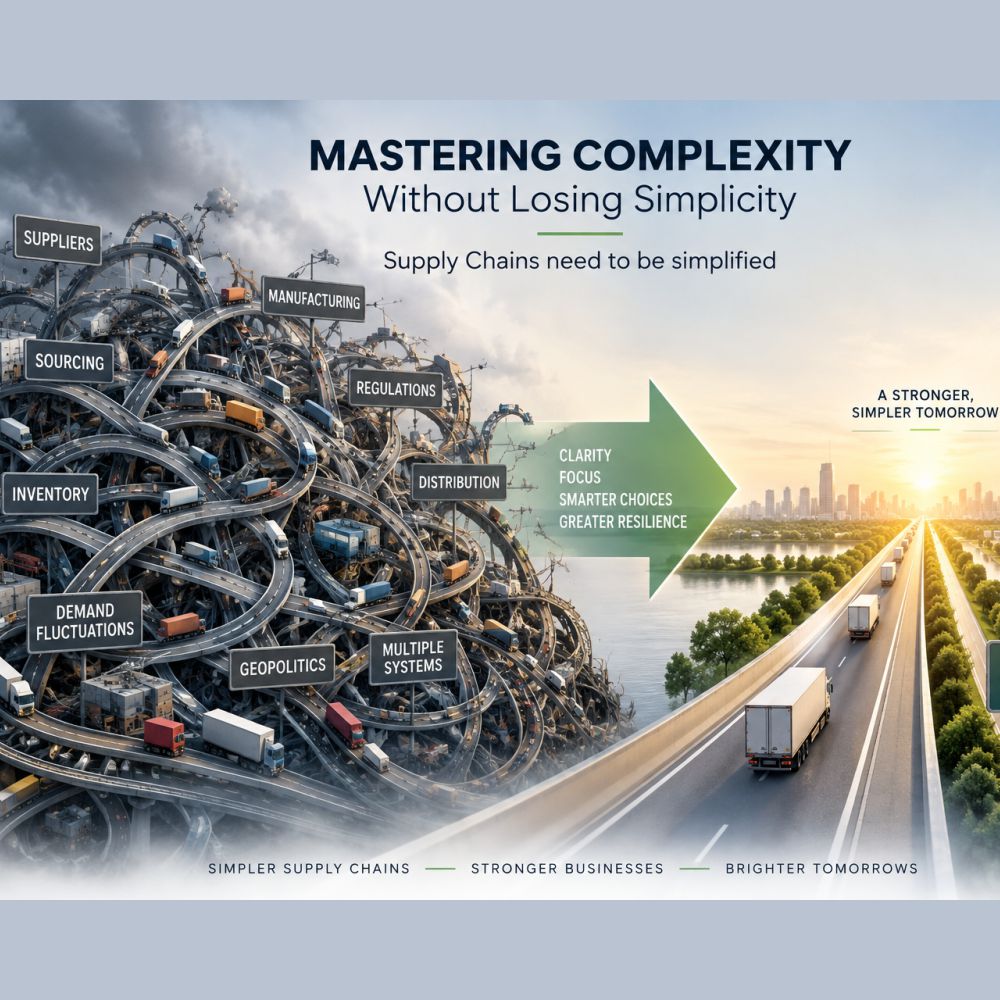
Supply chain excellence is rarely the result of a single initiative. It is shaped by the ability to see complexity differently, challenge established ways of working and turn transformation into meaningful business impact. The organisations featured here embody that approach. Recognised as winners of the Exemplary Supply Chains Enterprise Awards 2026, they have each taken on a distinct business challenge and responded with a combination of strategic thinking, operational rigour, innovation and technology.
What sets these journeys apart is not simply what was transformed, but the value that transformation created. By elevating supply chain from a transactional function to a strategic business capability, these organisations have unlocked greater agility, resilience, efficiency and competitive advantage. These are stories of ideas put into action, challenges turned into opportunities and supply chains designed not just to perform—but to make a difference. This is Part 2 of the two part article.
REDESIGNING THE NETWORK, REINVENTING PERFORMANCE
Johnson & Johnson Innovative Medicine India has strengthened its distribution network into a leaner, more agile and future-ready operating model. Through strategic redesign, data-led decision-making and disciplined execution, the organisation has enhanced supply chain resilience while protecting customer service and enabling sustainable business growth.
In healthcare, supply chain performance is directly linked to business continuity, customer confidence and availability of medicines for patients when and where they need them. The organisation needed a distribution model that could support evolving business needs while remaining compliant, responsive and resilient.
The existing network had evolved over time and had become increasingly complex. While it had served the business well in the past, future growth required a simplified, scalable and more efficient operating structure.
The opportunity was to move beyond incremental improvement and create a network that could deliver stronger performance, greater agility and improved readiness for future market requirements.
The challenge was to execute this transformation without disrupting operations. The programme required strong governance, cross-functional alignment and careful risk management to ensure service continuity throughout the journey.
THE SOLUTION
The organisation launched a structured network optimisation programme focused on building a more efficient, scalable and future-ready distribution model.
A cross-functional team brought together operational expertise, business insights and external perspective to shape a balanced and practical transformation roadmap.
Data and analytics were used to evaluate network options, test scenarios and guide decisions. This ensured that the future model was based on business needs, customer reach, operational efficiency and long-term scalability.
The redesign was supported by benchmarking and best-practice thinking, helping ensure that the new operating model addressed current opportunities while preparing the organisation for future growth.
Strong governance enabled clear decision-making, structured execution and proactive risk management across the transformation.
Implementation was approached in a disciplined and phased manner, allowing the organisation to validate changes, incorporate learnings and maintain operational stability.
The programme demonstrated how disciplined planning, collaboration and analytics-led execution can modernise a critical business capability without compromising service reliability.
THE IMPACT
The programme has delivered meaningful business value by strengthening efficiency, resilience and service continuity.
It has created a more agile and scalable supply chain platform, enabling the business to respond more effectively to changing market requirements.
The initiative has also simplified operations, improved governance and strengthened the organisation's ability to manage complexity with greater confidence.
Beyond operational benefits, the transformation has reinforced a culture of collaboration, disciplined execution and continuous improvement.
Most importantly, customer service remained protected throughout the transformation, demonstrating that strategic change can be delivered without compromising business continuity.
The journey continues as Johnson & Johnson Innovative Medicine India further advances its network agenda and builds stronger supply chain readiness for the future.
This transformation reflects more than network optimisation; it represents a strategic shift in how the organisation enables growth, resilience and customer trust. By combining data-driven thinking, cross-functional collaboration and disciplined execution, Johnson & Johnson Innovative Medicine India has created a future-ready supply chain model that supports business priorities today while preparing for the opportunities of tomorrow.
FROM FRAGMENTED FREIGHT TO INTELLIGENT FLOW
Enterprise freight is no longer defined by the movement of goods alone—it is defined by the quality of decisions made across the logistics lifecycle. As supply chains become increasingly complex, optimising isolated functions is no longer enough. Recognising this shift, Pando reimagined freight management through a unified operating architecture that seamlessly connects every stage of the freight lifecycle, enabling enterprises to replace fragmented execution with intelligent, end-to-end orchestration.
Enterprise logistics has long been constrained by fragmented technology. Most logistics platforms solve one challenge at a time—procurement, planning, visibility or invoicing—and gradually expand by adding adjacent capabilities. While each module delivers value independently, the absence of a unified architecture leaves enterprises managing disconnected data, delayed decisions and reactive operations.
Pando challenged this convention with a fundamentally different vision. Instead of building individual applications and integrating them over time, it was conceived as a unified freight operating platform from day one. Built on the belief that freight cannot be optimised in silos, the platform seamlessly connects procurement, planning, execution, visibility, audit and settlement into a single intelligent decision layer. Every logistics decision informs the next, enabling enterprises to operate with greater speed, control and confidence.
This philosophy was put to the test when one of India's leading AlcoBev enterprises selected Pando as its single freight operating platform across its manufacturing plants, depots and distribution network.
The organisation managed an extensive freight network spanning multiple plants, warehouses and distribution points. Yet every logistics function operated independently. Procurement teams negotiated carrier contracts that execution teams struggled to enforce consistently. Dispatch planning relied heavily on manual judgement and disconnected systems. Shipment visibility depended on multiple stakeholders, spreadsheets and constant follow-ups, while invoice verification remained labour-intensive, often stretching settlements over several weeks.
Although every team performed its individual role effectively, there was no unified operational view. Procurement operated on one set of data, execution on another, and finance on yet another. Exceptions were identified only after costs had already been incurred, while settlement delays created inefficiencies that rippled across the business. Freight data remained scattered across functions, making proactive decision-making nearly impossible. The logistics network existed, but nobody could see—or manage—it—as one connected system. The consequence was a freight operation that spent more time reacting to issues than preventing them.
THE SOLUTION
Rather than deploying individual modules, Pando implemented its complete end-to-end freight operating architecture. The platform established a unified decision layer spanning the entire freight lifecycle—Procure, Plan, Execute, Audit and Pay. Every function operated on the same contracts, shared data model and real-time operational context, creating a single source of truth across the enterprise.
Freight procurement was transformed through digital RFQs and AI-powered rate benchmarking, enabling competitive carrier sourcing while ensuring negotiated contracts remained enforceable during execution. Planning became intelligence-led through AI-driven load optimisation, automated dispatch planning and route optimisation, reducing manual interventions while improving asset utilisation and operational consistency.
Execution gained complete visibility. Every shipment across factories, depots and warehouses could be monitored through a single control layer with real-time tracking and automated exception management. Instead of chasing every shipment manually, operations teams focused only on exceptions that genuinely required intervention, improving responsiveness while reducing operational effort.
The final step closed the financial loop. Automated four-way invoice matching reconciled contracts, shipment data, electronic proof of delivery and invoices without manual verification. Audit accuracy improved dramatically, payment cycles accelerated and reconciliation effort was virtually eliminated.
For the first time, procurement decisions were directly linked to execution outcomes, deliveries seamlessly connected to settlements, and operational exceptions surfaced the moment they occurred rather than weeks later during financial reconciliation. Every stage of freight management now operated from a shared intelligence layer, enabling faster decisions, stronger governance and continuous optimisation. Pando's founding philosophy had become operational reality—not a collection of connected modules, but a single architecture designed to optimise freight end-to-end.
BUSINESS IMPACT
The transformation fundamentally changed how the organisation managed freight. A fragmented, manually intensive logistics function evolved into a connected, intelligence-driven operating model where every stakeholder worked from the same operational truth and decisions became proactive rather than reactive. The transformation delivered clear operational improvements across procurement, planning, execution and settlement.
These outcomes were not isolated efficiency gains. They reflected the power of an integrated operating architecture where every logistics decision strengthened the next, creating cumulative value across the freight lifecycle. What changed was not merely a set of performance metrics, but the very way the enterprise planned, executed and governed freight.
PROVEN AT SCALE
The AlcoBev transformation is not an isolated success. The same architecture has consistently delivered measurable outcomes across complex supply chain environments.
One of India's largest lubricant manufacturers—with a 20% market share across automotive and industrial segments—manages a highly complex logistics network spanning its manufacturing and distribution operations.
Before Pando, freight planning depended on manual coordination, hazardous goods movement relied on a limited pool of certified carriers, shipment visibility remained fragmented, and invoice audits were slow, error-prone and compliance-intensive. Carrier, driver and vehicle compliance checks were inconsistent, often leading to penalties, transit delays and hidden operational costs.
By deploying Pando's unified freight operating platform, the organisation digitised and automated the freight lifecycle end-to-end. AI-driven truck recommendations, intelligent order bundling, automated route optimisation, multi-pickup and multi-drop planning, real-time shipment visibility and automated invoice reconciliation transformed both operational execution and financial governance.
- 10% reduction in freight costs through AI-led rate benchmarking and digital procurement across more than 100,000 freight lanes.
- 100% invoice audit accuracy through automated four-way matching of contracts, shipment data, ePODs and invoices.
- 70% reduction in invoice processing cycle times, accelerating settlements while eliminating manual reconciliation.
- 20% improvement in working capital through faster invoice closure and streamlined payment workflows.
- An additional 3–5% year-on-year logistics savings driven by continuous lane benchmarking, carrier performance optimisation and network intelligence.
These implementations reinforce a simple but powerful truth: enterprise logistics transformation cannot be achieved by optimising individual processes. It requires reimagining the operating architecture itself.
REDEFINING THE FUTURE OF ENTERPRISE FREIGHT
Pando's innovation lies not in automating individual logistics functions, but in fundamentally redesigning how enterprise freight operates. By connecting procurement, planning, execution, visibility, audit and settlement through a single intelligent architecture, it enables enterprises to move from fragmented, reactive operations to connected, data-driven decision-making. The success of the AlcoBev transformation—reinforced by similar outcomes across leading enterprises—demonstrates that this is far more than a technology deployment. It represents a new operating model for enterprise freight, one that consistently delivers measurable improvements in cost, agility, governance and working capital.
Today, Pando powers 100+ enterprise implementations across 15+ industries in 20+ countries. This scale reflects an architecture built to scale, adapt and deliver sustained value across diverse industries and increasingly complex logistics networks.
By proving that meaningful logistics transformation comes not from digitising isolated functions but from redesigning the freight operating model itself, Pando has established a new benchmark for enterprise freight management. More than a technology platform, it represents a new blueprint for intelligent, connected and resilient freight operations—one that is shaping the future of enterprise logistics.
A BLUEPRINT FOR INTELLIGENT PHARMACEUTICAL DISTRIBUTION
In pharmaceutical supply chains, the final mile is where operational excellence is truly tested. Every shipment represents a commitment to maintain product integrity, meet regulatory expectations and ensure that critical medicines reach customers and patients safely. As pharmaceutical distribution continues to evolve with increasing temperature-sensitive therapies, expanding geographical requirements, higher compliance expectations and growing sustainability priorities, PharmaPoint Group recognised the need to move beyond traditional distribution practices. The objective was clear: Build a supply chain model that combines technology, operational agility and strong process discipline to deliver consistent performance at scale.
The pharmaceutical logistics environment presents unique challenges. Maintaining the required temperature conditions across diverse Indian geographies, particularly under varying climatic conditions, requires robust processes, reliable infrastructure and continuous monitoring. At the same time, increasing regulatory scrutiny has created the need for stronger documentation, traceability and visibility across the entire distribution journey. Traditional approaches also created challenges around inventory planning. Balancing product availability with inventory efficiency required better forecasting capabilities and a more data-driven approach to demand management. For PharmaPoint, the challenge was not limited to transporting medicines safely, it was about creating an integrated operating model that could balance quality, compliance, sustainability and business efficiency.
BUILDING AN INTELLIGENT COLD CHAIN ECOSYSTEM
Recognising that individual improvements would not be sufficient, PharmaPoint embarked on a comprehensive transformation programme focused on strengthening three critical areas: packaging innovation, digital visibility and smarter inventory management.
STRENGTHENING COLD CHAIN RELIABILITY THROUGH INNOVATION
Temperature-controlled distribution requires solutions that can provide consistent performance while supporting sustainability objectives. PharmaPoint adopted advanced packaging solutions, including Phase Change Material (PCM)-based insulated shippers, to strengthen temperature management capabilities and reduce dependence on conventional packaging methods. These innovations supported improved thermal performance while aligning with the organisation's focus on more responsible and sustainable distribution practices.
Creating Greater Visibility Through Digital Enablement - Visibility is the foundation of a responsive supply chain. Through digital monitoring capabilities and IoT-enabled solutions, PharmaPoint enhanced its ability to track critical shipment parameters, identify exceptions and take timely corrective actions. This transition enabled a shift from reactive management to a more proactive approach, allowing teams to make faster and better-informed decisions while strengthening product integrity throughout the distribution journey.
IMPROVING PLANNING THROUGH DATA-LED INTELLIGENCE
Inventory optimisation was another important focus area of the transformation. By leveraging analytics, historical consumption patterns, regional demand insights and supply trends, PharmaPoint strengthened its forecasting and planning processes. This helped improve inventory positioning, support product availability and reduce inefficiencies associated with traditional planning approaches.
COLLABORATION THAT MADE TRANSFORMATION POSSIBLE
Technology was an important enabler, but the success of the transformation was driven by people and collaboration. Teams across Supply Chain, Quality, Technology, Procurement and Commercial functions worked together to redesign processes, address operational challenges and create solutions that could be effectively implemented across the network. PharmaPoint also worked closely with logistics partners and service providers to ensure alignment across the broader supply chain ecosystem. The implementation followed a structured approach, with pilots and continuous improvements helping refine processes before wider adoption. This collaborative model ensured that transformation was not limited to systems and tools, but became embedded into the organisation's way of working.
DELIVERING MEASURABLE BUSINESS IMPACT
The integrated transformation has strengthened PharmaPoint's distribution capabilities across multiple dimensions. Improved visibility has enhanced operational control and enabled faster response to potential disruptions. Better planning practices have supported improved inventory management and greater supply chain efficiency. Sustainable packaging initiatives have contributed towards reducing waste while maintaining the highest standards of product protection.
The initiatives have also supported improvements in:
- Cold chain reliability and compliance management
- Inventory optimisation and operational efficiency
- Shipment visibility and traceability
- Sustainable distribution practices
- 35% reduction in non-biodegradable packaging waste
- 18% reduction in working capital
- 35% decrease in packaging waste
- 99%+ service level achievement
- 100% real-time visibility of every dispatch
- Immediate batch-level traceability for recalls
- 100% audit-ready digital compliance documentation
Most importantly, these improvements have been achieved while maintaining PharmaPoint's commitment to service excellence and ensuring that customer and patient needs remain at the centre of every decision.
CREATING A FUTURE-READY DISTRIBUTION MODEL
The transformation represents more than an operational improvement; it represents a fundamental shift in how pharmaceutical distribution can be managed. By combining technology, data-driven decision-making, sustainable practices and cross-functional collaboration, PharmaPoint has created a scalable framework designed to support future growth and evolving healthcare requirements.
The journey continues as PharmaPoint explores new opportunities to further enhance digital capabilities, strengthen operational resilience and deliver greater value across the healthcare ecosystem. Because in pharmaceutical distribution, excellence is not only measured by moving products efficiently, it is measured by the confidence that every medicine reaches where it is needed, safely and reliably.


 Categories