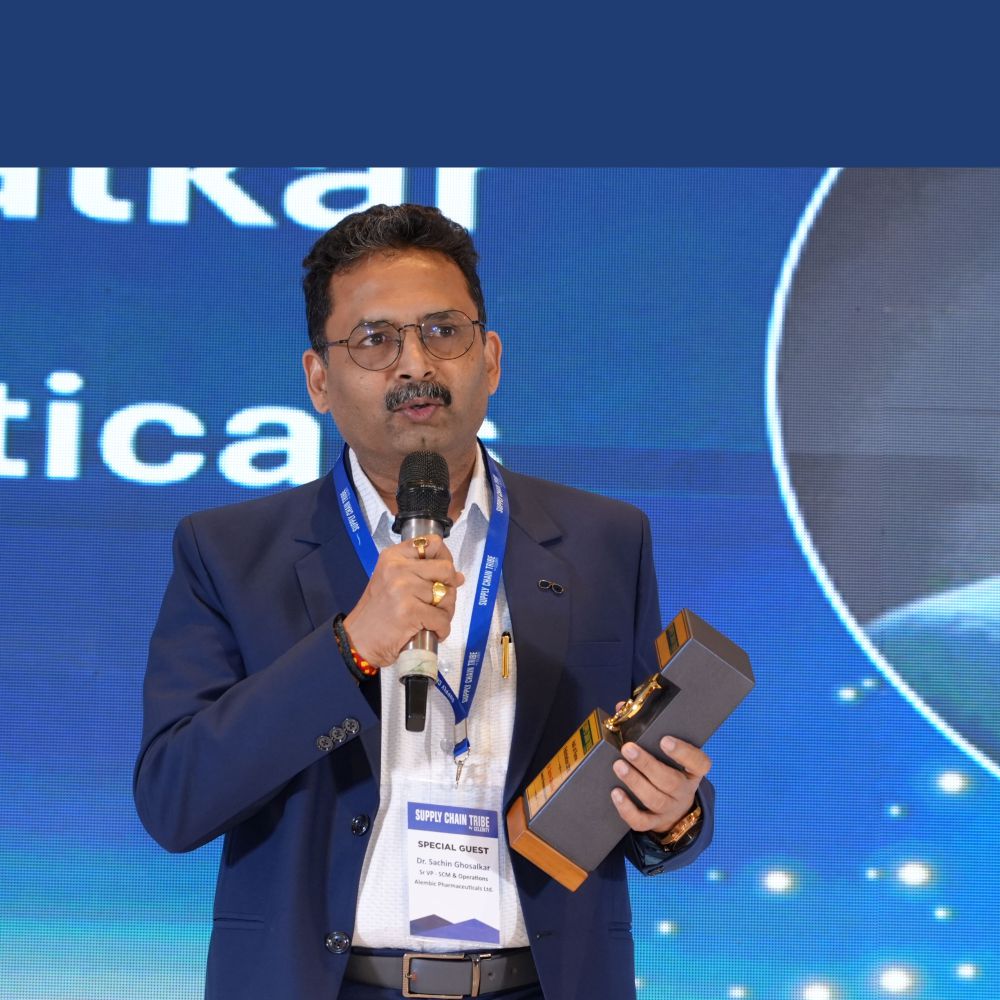
In a fast-evolving business landscape, experience provides crucial context—but true impact requires a willingness to listen, unlearn, and stay open to fresh perspectives. Dr. Sachin Ghosalkar, Senior Vice President – SCM & Operations, Alembic Pharmaceuticals Ltd., believes that leadership is a responsibility earned through integrity and trust rather than authority. In this insightful conversation, Dr. Ghosalkar reflects on the core principles that guide his decision-making, the enduring power of active listening, and how emerging leaders can define their own meaningful path to success.
After a career of sustained achievement, what would you describe as your personal success mantra and how has it evolved with experience?
My success mantra has always been quite simple: stay curious, stay consistent, and stay grounded. Earlier in my career, I probably associated success more closely with achievement, setting ambitious targets, taking on challenging assignments and delivering results. Those things remain important, but experience has changed the way I look at success. Over time, I have come to believe that a career is not defined by a few big milestones. It is built through the choices you make every day, how you treat people, how you respond when things don’t go as planned, and whether you continue to learn even after you become experienced.
I have also learned to look at setbacks differently. They are frustrating at the time, but they often teach you things that success doesn’t. They make you reassess your assumptions and sometimes open doors you hadn’t considered. Today, I would define success as continuing to grow, doing work that creates value, developing people around me, and being able to look back at the journey with a sense of integrity and satisfaction.
Is there a book that has had a lasting influence on the way you think or lead? Is there a particular idea from it that you have consciously brought into your own life or leadership?
A book that has stayed with me over the years is Man’s Search for Meaning by Viktor Frankl. What I took from it was the idea that circumstances may not always be within our control, but our response to those circumstances is. That is a particularly powerful lesson in leadership because uncertainty, setbacks and situations you cannot control are inevitable. I have tried to apply that thinking throughout my career. When something doesn’t go according to plan, I try to spend less time asking why it happened and more time asking, “What can we do from here?”
I also think the book reinforces the importance of purpose. People are willing to work through difficult situations when they understand why the work matters and what they are contributing to. For me, leadership is not only about delivering results. It is also about giving people a sense of purpose and perspective, particularly when the path ahead is uncertain.
Mentors can shape a leader long after a particular chapter has ended. Which mentor or influence has had a lasting impact on you, and what aspect of their thinking continues to stay with you?
One of the most important lessons I received from a mentor was that leadership is ultimately about the people you develop, not the position you hold. What I particularly admired was the way this person listened. They didn’t feel the need to have the first answer in every conversation. They would ask questions, understand the situation and then allow the person in front of them to arrive at the answer wherever possible. That has stayed with me.
As you become more senior, it can be tempting to solve everything yourself because you have the experience to do so. But if you are constantly providing the answers, you may be solving today’s problem without developing the person who will face tomorrow’s. I have therefore tried to give people responsibility, allow them to make decisions, and give them the space to learn, even when their approach may be different from mine.
The best mentors, I believe, don’t simply give you advice. They influence the way you think. That is the part of mentorship I have tried to carry forward.
You have led across generations with very different expectations of work, purpose and success. How do you adapt your leadership to connect with younger professionals while allowing them the space to bring their own strengths and perspectives?
I don’t think leadership across generations is about finding a different leadership style for every age group. It is about understanding the individual. Younger professionals today may have different expectations around career growth, flexibility, technology and purpose. I don’t see those differences as a problem. In fact, they can be very useful because they force established leaders to question some of their own assumptions.
My approach is to be very clear about what needs to be achieved and why, while giving people flexibility in how they achieve it. I also believe younger colleagues should be able to question established ways of doing things. Experience gives you context, but it does not mean that every way of working from the past remains the right way of working today.
As a leader, I want people to feel comfortable saying, “I think there is a better way of doing this.” Of course, that comes with accountability. You have to be willing to stand behind your ideas and deliver results. Ultimately, I don’t want people to become leaders who simply imitate me. I want them to develop their own style, based on their strengths and their understanding of the situation.
As a new generation of leaders enters positions of greater responsibility, what qualities do you believe will become increasingly important and which qualities remain timeless?
The ability to adapt will become increasingly important. The pace at which technology, markets and organisations are changing means that leaders cannot depend entirely on what worked in the past. They have to be willing to learn, unlearn and sometimes change their minds. I also think leaders will increasingly need the ability to bring together people with very different expertise and perspectives. No leader can be an expert in everything, so knowing how to ask the right questions and bring the right people together becomes extremely important. But there are certain qualities that I don’t think will ever change: integrity, empathy, accountability, humility and courage.
Technology may change the way we work, but people still want to work with leaders they can trust. They want leaders who take responsibility when things go wrong, give credit when things go right, and are willing to make difficult decisions when required. If there is one thing I would emphasise, it is that leadership is not about having all the answers. As you become more senior, it becomes increasingly important to know which questions to ask and whom to ask them of.
The business environment continues to change at remarkable speed. What do you do personally to remain open to new ideas, new ways of working and perspectives that may be very different from your own?
I try to remind myself that experience is useful, but it can also create assumptions. When you have been in an industry for many years, you develop patterns of thinking based on what you have seen before. Those patterns are valuable, but they can also make you dismiss something simply because it is unfamiliar. I therefore try to stay curious. I read, speak to people across different functions and generations, and make an effort to understand what is changing outside my immediate area of work.
I particularly enjoy conversations with younger colleagues because they often approach familiar problems very differently. They may question something that everyone else has simply accepted as “the way things are done.”
I also believe in experimentation. You don’t necessarily have to make a major commitment to every new idea. Sometimes it is better to test something on a small scale, learn from it and then decide whether it deserves a larger investment. For me, staying open to new ideas doesn’t mean accepting every new idea. It means being willing to listen properly before deciding.
Having worked with people across different generations and personalities, what do you look for beyond credentials when you recognise someone with the potential to lead?
Credentials tell you what someone has achieved. They don’t necessarily tell you how that person will behave when things become difficult. Beyond qualifications and experience, I look for curiosity, ownership and character. I pay attention to how someone responds when they make a mistake. Do they try to explain it away, or do they take responsibility and learn from it? I also look at how they treat people who cannot offer them anything in return.
Another important quality is curiosity. People with leadership potential usually want to understand the bigger picture. They ask questions, they don’t pretend to know everything, and they are comfortable learning from people who may have less experience than them.
I also look for people who make those around them better. If someone is willing to share knowledge, develop colleagues, give credit to others and bring people together, that tells me a great deal about their leadership potential.
A leadership title can be given to someone. Leadership itself has to be earned.
Over the years, has there been a leadership practice or principle that has become so integral to the way you work that it now comes almost instinctively?
If there is one practice that has become almost instinctive for me, it is listening before responding. Earlier in my career, I was probably more focused on having the answer quickly. With experience, I have realised that the first answer is not always the best answer, and sometimes the person closest to the problem knows more about it than the person sitting at the top of the organisation. So I try to understand the situation before forming a view. I ask questions, listen to different perspectives and try to separate the facts from assumptions.
I also want people to be comfortable telling me when something is not working. If people only tell a senior leader what they think the leader wants to hear, the organisation eventually becomes disconnected from reality. Creating that openness doesn’t mean there is no accountability. Quite the opposite. People should be able to disagree openly, but once a decision is made, everyone should be committed to executing it. Over the years, I have found that good listening often leads to better decisions and, just as importantly, stronger teams.
What interests outside business continue to hold your attention, and have any of them influenced the way you approach your professional life?
Outside work, I enjoy reading, travelling and, perhaps most importantly, spending time with people and having conversations that have nothing to do with business. Travel has probably influenced me more than I initially realised. It reminds you that your own way of doing things is not necessarily the only way. You encounter different cultures, different priorities and completely different ways of looking at everyday problems. Reading has a similar effect. It gives you the opportunity to step outside your immediate environment and see situations through someone else’s experience.
I also value conversations with people from different backgrounds and generations. Some of the most interesting ideas don’t necessarily come from formal meetings or business discussions. I think those interests have helped me professionally by keeping me curious and reminding me that there is always more than one way of looking at a problem. And perhaps most importantly, having interests outside work gives you perspective. At the end of the day, a person’s identity is much bigger than their designation.
Having experienced leadership across several decades, what is one perspective you believe the next generation would benefit from carrying forward and what would you encourage them to define for themselves?
One thing I would encourage the next generation to carry forward is the understanding that leadership is a responsibility, not simply a position. A designation gives you authority, but what you do with that authority determines the kind of leader you become.
Trust takes years to build and can be lost very quickly. So I would encourage young leaders to protect their credibility, keep their commitments and treat people with respect, particularly when there is pressure to do otherwise. At the same time, I would encourage them not to simply inherit someone else’s definition of success.
Everyone’s journey is different. For some, success may mean building a large business. For someone else, it may mean becoming an expert in their field, building strong teams, creating something new, or maintaining a fulfilling life alongside a successful career. And that definition can change with time. What motivates you at 30 may not be what motivates you at 50.
So my advice would be: Carry forward the values that have stood the test of time, but have the courage to define your own destination.


 Categories